
Google isn't the internet: what Yandex taught me about building a business across borders
Our Moscow site hit number one on Yandex while sitting around 30 on Google for the same search. Here's what that taught me about local intent, Yandex vs Google SEO, and why the internet is not one market.
Cross-border AI marketing expert running content and search systems across Google, Bing and Yandex in English and Russian. Specialises in supplement and sports-nutrition brands. Founder of Staffless and of 13Lives, sold in three countries.
Is Yandex SEO different from Google SEO?
Not at the foundations. Both reward useful, people-first content written from real experience. What showed up for us was regional relevance: Yandex can take a site's region into account for location-dependent searches. Our Moscow Expat Events site, which is about Moscow in its name, domain, topics and stories, reached number one on Yandex for the search we were tracking while sitting around 30 on Google. Be specific about where you're relevant and Yandex can reward it.

If you've built a business in the West, there's a pretty good chance that when somebody says SEO, your brain automatically says Google.
Mine did too.
I've spent years building businesses, selling products, working with distributors, running social media, learning digital marketing and trying to work out how the hell you get people to actually notice what you're doing. I've operated across Australia, New Zealand, New Caledonia, India, Germany, Austria, Northern Ireland and now Russia.
And one thing I've learned from all of it is this: the internet is not one market.
The person sitting in Sydney isn't necessarily searching, buying or making decisions the same way as someone sitting in Delhi. Someone in Moscow isn't necessarily using the same platforms as someone in London. Even when the technology looks almost identical, the behaviour behind it can be completely different.
Recently, Yandex reminded me of that in a pretty big way.
Russia and what I call the Parallel Universe Effect
There was a show I watched when I was younger called Sliders. The whole idea was that a group of people travelled through parallel universes. Sometimes the world they landed in was obviously completely different. Other times it looked almost exactly like home. Same streets. Same buildings. Same people.
Until they noticed one tiny detail. A gate opened the wrong way. Something that should have been there wasn't. And suddenly they knew: this isn't our universe.
That's probably the best way I can explain Russia to someone who hasn't spent much time here. Russia has what I call the Parallel Universe Effect.

You arrive and so much feels familiar. People order food. They use taxis. They shop online. They go to restaurants, start businesses, buy houses. They use social media, delivery apps, digital payments and online marketplaces.
And then you start actually living here. That's when you notice all the little differences. How people communicate. How they buy. How they negotiate. How meetings work. How they see money. How trust is built. How businesses present themselves. How people search for things. How entire digital ecosystems operate.
None of these things individually seems massive. But add them together and suddenly you're playing in a very different market. Every industry has its own version of this too, which I've written about in every industry has a hidden language. Countries just make it louder.
India was the first market that really taught me this
When I first started taking 13Lives international, I was mostly working B2B. And B2B protects you from a lot of this.
You find a distributor. The distributor understands the country. They know the customers. They know the retailers. They understand the culture. And they take a lot of the local headaches off your hands.
At the time, I thought that was fantastic. Looking back, I realised it can also become a weakness, because the brand owner stays inside their bubble. You start assuming that selling is selling. Then you actually get on a plane and realise it isn't. (In supplements especially, what you're even allowed to say changes from country to country, which I've covered in marketing a supplement brand when you can't make claims.)
India was probably the biggest wake-up call for me. I spent time in New Delhi and Srinagar and found a market using plenty of technology that was familiar to me, but using it in its own way. Influencers carried huge weight. Instagram was massive. Certain personalities were treated much more like traditional celebrities. The way people interacted with brands was different. The way status worked was different. The way credibility worked was different.
Same internet. Different people. And therefore, different rules.
Somewhere along the way I became fascinated by how cultures make money
I've always enjoyed travelling and understanding different cultures. But eventually I realised something. If you really want to understand a group of people, don't only look at what they eat or what music they listen to. Look at how they make money.
How do people sell? How do they buy? What makes them trust somebody? What makes them suspicious? What does success look like? What makes somebody spend? How do businesses communicate?
That's where things get really interesting. And it's one of the reasons the international side of Staffless has always appealed to me. I don't want to build something that only understands one little corner of the internet. The future is bigger than that.
Then we started seriously looking at Yandex
This part is still relatively new for me, and that's what makes it exciting.
I'd spent years learning Google, Western social media platforms and the digital systems we tend to use in Australia and other Western markets. Then I started getting properly hands-on with Yandex, and the best way I can describe the feeling is that it felt a little bit like discovering fire. I'd been cooking the food already. I'd found ways to get the job done. And then suddenly: hang on, what's this thing?
Yandex isn't some primitive alternative to Google either. Far from it. Some parts are incredibly straightforward once you understand where everything is. Other parts are structured completely differently. And that's the challenge: you have to stop forcing your existing mental model onto it and actually learn how the system works.
Then something happened. We started getting results.
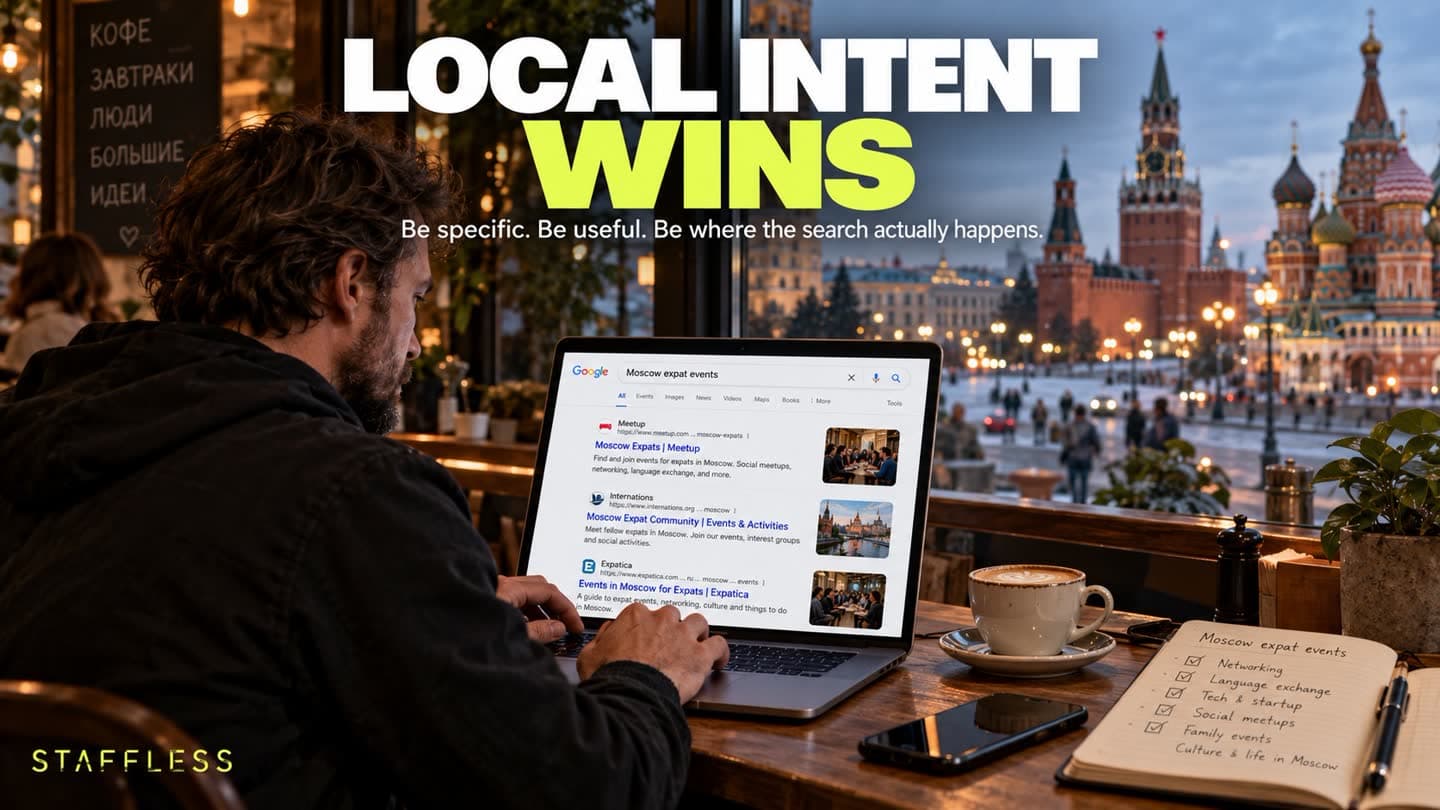
Moscow Expat Events: number one on Yandex, around 30 on Google
Moscow Expat Events is almost ridiculously specific. The name tells you what it is. The domain tells you what it is. The content tells you what it is.
We weren't trying to write 600 generic blogs about every possible subject. We wrote about things we were actually experiencing. Moving to Moscow. Making friends. Life here. Raising children here. Finding communities. Going places. Meeting people. The kind of information somebody might genuinely want if they'd just arrived in Moscow and were trying to build a life.
And that's important. My wife and I weren't sitting in another country asking AI to write "TOP 10 AMAZING THINGS TO DO IN MOSCOW!!!" We were here, actually doing it. So the content had a voice, it had experience behind it, and it had a very specific audience.
Then I checked our search position. For the search we were tracking, Moscow Expat Events had reached number one on Yandex. On Google, we were sitting much further back, around the 30 mark when I checked.
Rankings move, location matters, and results change between users, so treat those as positions we observed at the time, not permanent facts. But the difference was big enough that I couldn't ignore it.
Then Staffless itself started moving. A fresh company, a fresh website, and we saw it reach roughly number six on Yandex for the search we were monitoring. At that point I'm thinking: okay, there's something here.
I came. I saw. I conquered. Well… sort of. We're still figuring the bloody thing out. But that's half the fun.
So is Yandex SEO completely different from Google SEO?
No. And I don't want to turn this into one of those articles where somebody discovers a new platform and suddenly tells you everything you've ever learned is wrong.
Both platforms want to return useful information. Google says its systems are designed to prioritise helpful, reliable, people-first content, rather than material created primarily to manipulate search rankings.
Yandex has a lot going on under the hood too, but one area was particularly relevant to what we were doing: regional relevance. Yandex's own Webmaster documentation says a site's region can be taken into account for location-dependent searches. Their example is basically common sense: if someone in Moscow searches for a local service, sites assigned to Moscow are likely to matter more. You can set your site's region in Yandex Webmaster, and having a region doesn't stop you showing up for people elsewhere.
That's when our Moscow Expat Events result started making a lot of sense to me. We had Moscow in the brand. Moscow in the domain. Moscow in the subject, the experiences and the stories. And actual people in Moscow writing for people interested in Moscow.
We weren't trying to be relevant everywhere. We were trying to be really relevant somewhere. That's a very different mindset.
What I'd take from it if you want to rank on Yandex
If you want the short, practical version, this is what I'd take away:
- Pick one place and say it everywhere: in the name, the domain, the headings and the stories, so there's no doubt where you're relevant
- Write from first-hand experience: people who actually live there, writing about things they actually did
- Write for a narrow audience: someone who has just arrived, not "everyone interested in Russia"
- Check your site's region in Yandex Webmaster rather than leaving it for Yandex to guess
- Don't chase one engine with tricks: the same usefulness that works on Yandex works on Google
SEO people sometimes forget there's a human on the other side of the search bar
I've been in sales for around 15 years, and sales teaches you something pretty quickly. When somebody walks through your door looking for something, eventually you learn to read the room. What are they actually asking for? What problem are they trying to solve? What are they worried about? What do they want?
Digital marketing sometimes manages to beat that instinct out of people. Suddenly everything becomes keywords, backlinks, search volume, click-through rates, Core Web Vitals, conversions, funnels and dashboards. And yes, obviously that stuff matters. But somewhere underneath all of it is still a person trying to find something.
For Moscow Expat Events, the question we kept coming back to was incredibly simple: what would we have wanted to know when we first arrived here?
That's it. That's the strategy. Then we build the technical side around the answer, not the other way around. And funnily enough, Google's current guidance talks heavily about first-hand expertise, original information and creating useful content for people rather than pumping out material mainly to attract search traffic. Sometimes the clever strategy is just being useful.
This is where the next five years get really interesting
Forget SEO for a second. Look at business. Look three years ahead. Five years. Seven years. Where is your company going to exist?
One thing I don't understand is why a business would deliberately restrict its message to one part of the world. We live in a period where the internet is becoming more fragmented: different search engines, payment systems, marketplaces, social networks, regulations, languages and ecosystems. Even search itself is splitting, with more people asking AI assistants instead of typing into a search box, which I've written about in AI SEO is the future. And new platforms keep crossing borders, as Bilibili going global shows.
Okay. Learn them. Because what happens if you start building your presence now? What happens when your competitor notices another market five years from now, but you've already spent five years learning it?
You've already made mistakes. You've already built authority. You've already created content. You've already developed relationships. You've already worked out what people respond to. That isn't a small advantage. It can be the difference between entering a market and already belonging in it.
You don't need to know everything about every country
This is probably where somebody reading this thinks: "That's great, Vlad. Am I supposed to become an expert on 190 countries now?" No. Of course not. Nobody is born with the ability to stare across the planet and magically understand everyone living on the other side.
There are really only two ways I've found to learn it. You get on the plane and work it out yourself, or you learn from somebody who already has.
I've done a lot of the first option. I've gotten on the plane. I've sat in the meetings. I've been confused. I've made mistakes. I've dealt with distributors. I've watched customers. I've seen things that work in Australia completely fail somewhere else, and I've watched strategies I'd never considered work incredibly well because the local market understood something I didn't.
That's why I enjoy it. You're constantly learning and constantly having your assumptions challenged. And now Russia is teaching me another version of exactly the same lesson. I'm mapping the journey while I'm walking it.
If you remember one thing from this article
You don't need to be everywhere. But you do need a signal in the right places.
If your entire strategy is "we rank on Google in Australia, so we're sorted", maybe that's enough for you. But if you're building something with international potential, start looking further ahead. Find where your future customers actually are. Find what they actually use. Learn how they search, what they trust, and what sounds normal to them.
And then start building. Not when everybody else arrives. Before.

Build where the world is going
Most businesses wait until the next market opens up. Then they scramble. We think you should already be there.
That's what we're building at Staffless: helping businesses understand where the world is going, build their presence early, and operate across markets without needing a massive team behind them. Because the business you're building today shouldn't only work in the market you're sitting in today.
If you're looking three, five or seven years ahead and wondering where your brand could go next, talk to Staffless. Let us look at what you're building and where it could be playing, and let's start building that position before everyone else gets there.
Official references
- Google Search Central: Creating helpful, reliable, people-first content
- Yandex Webmaster: Site region
Frequently asked questions
- Is Yandex SEO different from Google SEO?
- Not at the foundations. Both reward useful, people-first content and good technical basics. The practical difference we saw was regional relevance: Yandex can take a site's region into account for location-dependent searches, so a site that is clearly about one place can outrank larger, more general sites there.
- Why would a site rank higher on Yandex than on Google?
- Different engines weigh signals differently. In our case, a very specific, first-hand site about life in Moscow reached number one on Yandex for the search we tracked while sitting around 30 on Google. Strong regional relevance and a narrow, genuine audience appear to have counted for more on Yandex. Rankings vary by user, location and date, so treat any single position as a snapshot.
- How do I tell Yandex which region my site serves?
- Yandex Webmaster lets you specify your site's region and change it if Yandex has guessed wrong; it can also use your organisation's details from Yandex Business. Assigning a region doesn't hide the site from users elsewhere if the content is relevant to their search.
- Do I need to optimise for Yandex if I sell into Russian-speaking markets?
- If those markets matter to your business, yes. Ranking on Google in one country tells you nothing about how you show up where your next customers search. Start with useful, first-hand content in the local language, make your region clear, and add Yandex Webmaster alongside Google Search Console.
Want us to find your leaks for you?
A $300 website and social audit, reviewed the way your customer sees it. Credited to your first month.
Book your audit →Keep reading