
Bilibili is going global. Should you actually join?
A platform most of the West has never opened just crossed the border with 376 million users behind it. We work across borders for a living, so we went and had a proper look.
Cross-border AI marketing expert running content and search systems across Google, Bing and Yandex in English and Russian. Specialises in supplement and sports-nutrition brands. Founder of Staffless and of 13Lives, sold in three countries.
Should creators join Bilibili right now?
Reserve your name and start testing it, but don't move your whole channel. Bilibili is real, it's enormous in China, and it costs nothing to cross-post to. But international payments aren't confirmed yet, so treat any money from it as a bonus, not a plan. It's a place to win attention, not somewhere to rely on for income.
In 2009, a handful of anime and gaming obsessives in China built a little video community for people like them. Bullet comments flying across the screen, niche fandoms, the stuff nobody in the West was paying attention to. They called it Bilibili.
Seventeen years later that little community has 376 million people on it every month, turns a real profit, and has just stepped out of China and onto the world stage. And the internet has immediately started asking the only question that matters: is this the next TikTok? A new emperor in the streaming space? The competitor YouTube has never actually had?
That's a story worth taking seriously, and here's why it's us telling it.
We're a cross-border tech studio. Working between markets, between languages, between platforms most people treat as separate worlds — that's the actual job. So when a Chinese platform the size of a country tries to cross a border, that's not passing news to us. That's our field. We set up an account, poked at it, and worked out what it means for a creator, especially the ones the West forgot to keep paying.
First, the myth: this is not a new app
Every headline calls Bilibili a “new YouTube competitor.” It's about as new as the iPhone. It's seventeen years old, it survived and grew through an era that killed a hundred other video sites, and it did that inside the most competitive internet market on earth.
That matters, because a brand new startup asking for your content is a gamble. A profitable seventeen-year-old company with 376 million users, finally turning outward, is a different kind of bet. The machine works. The only open question is whether it works for you, in your language, in your country. Which is a much better question to be asking.
What it actually feels like to use
I downloaded it. Took a few minutes.
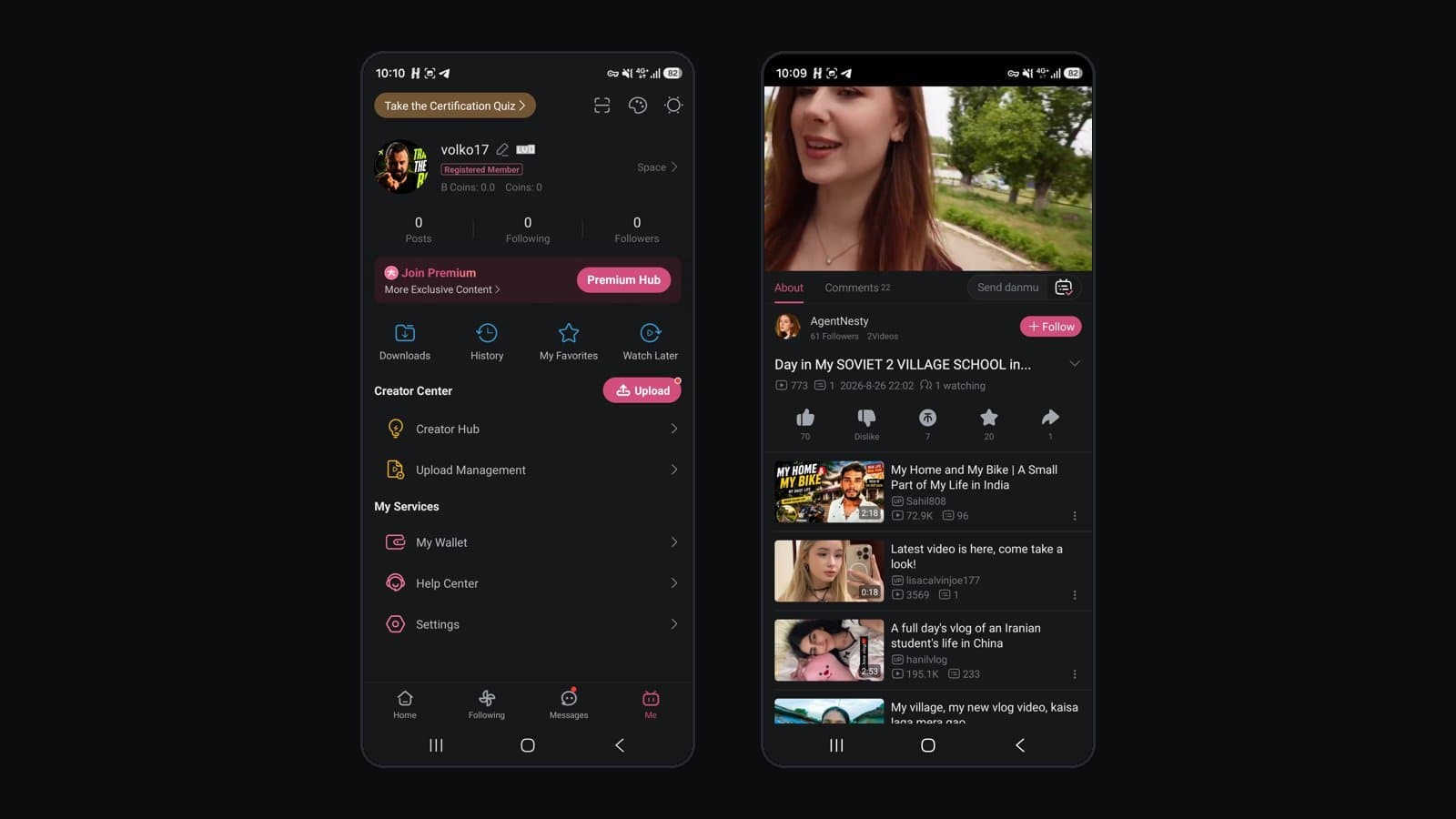
The one genuinely annoying bit was the Google Play store, where you get a pile of Chinese versions and then the real international one, which you spot because it's the only English listing. After that, easy. No VPN, no uploading a passport just to post, which after the last few years is a small relief on its own.
Honest comparison? It feels like early TikTok. Not the polished, everything-in-its-right-place machine YouTube gives you, but there's enough there that you look at it and think, yeah, I can work with this. It's a real platform, not a demo.
One detail you only catch by actually using it: your channel name has to match your handle. You can't run a display name that's different from your @ the way you can on YouTube. Minor, but worth knowing before you pick one.
The numbers, and the trap inside them
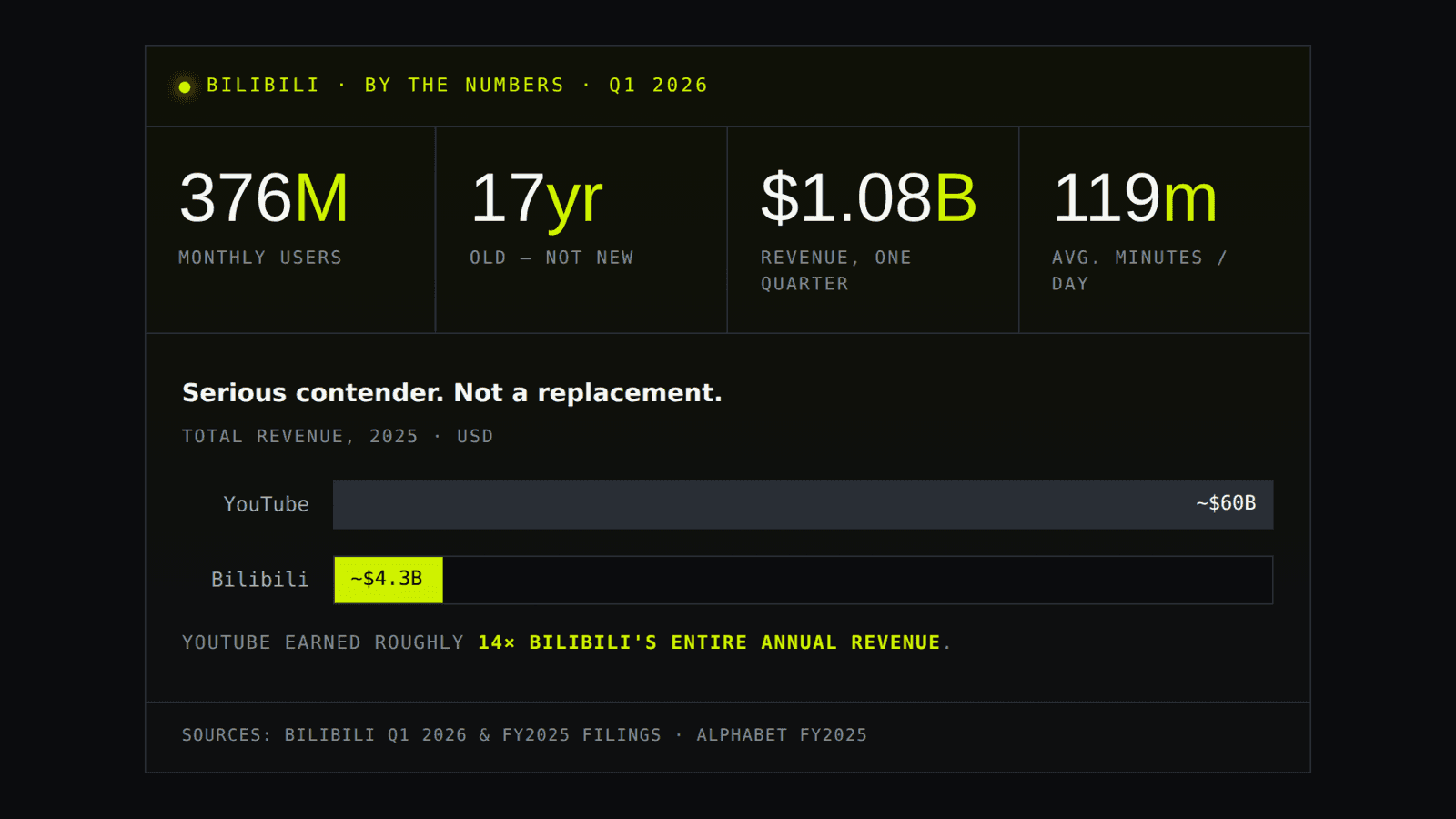
The size is genuinely serious. First quarter of 2026: over 376 million people a month, more than 115 million a day, two hours a day each, about 1.08 billion US dollars in revenue for the quarter, and an actual profit. This isn't a cash-burning experiment hoping to be bought. It's a real business.
But here's the trap in that number, and the hype relies on you not noticing it. Almost all 376 million of those people are in China, on the established Chinese side. The international app is days old by comparison. So that number is proof the engine runs, not proof there's a Western audience sitting there waiting for you. Two very different things.
And for scale, the thing everyone skips: YouTube pulled in more than fourteen times Bilibili's entire annual revenue last year. So call it a competitor, fair. Call it a replacement, and you're not looking at the numbers.
Who it's for, and the angle nobody's taking
The obvious fits are the visual, fandom-driven stuff: animation, gaming, tech, science, education, music, anime, anything that still makes sense after it's dubbed.
But here's the opening I can see precisely because of the world we work in.
If you're a Western creator living in Russia, making content about Russia, this platform was practically built for you. China is genuinely fascinated by Russia — the land, the culture, the ordinary day-to-day of it — and that content is evergreen. It doesn't rot. Putting it in front of a Chinese audience is worth more, in a lot of cases, than leaving it on YouTube alone.
I didn't just guess at that. I searched “russia” on the app to see what was actually there. Have a look.
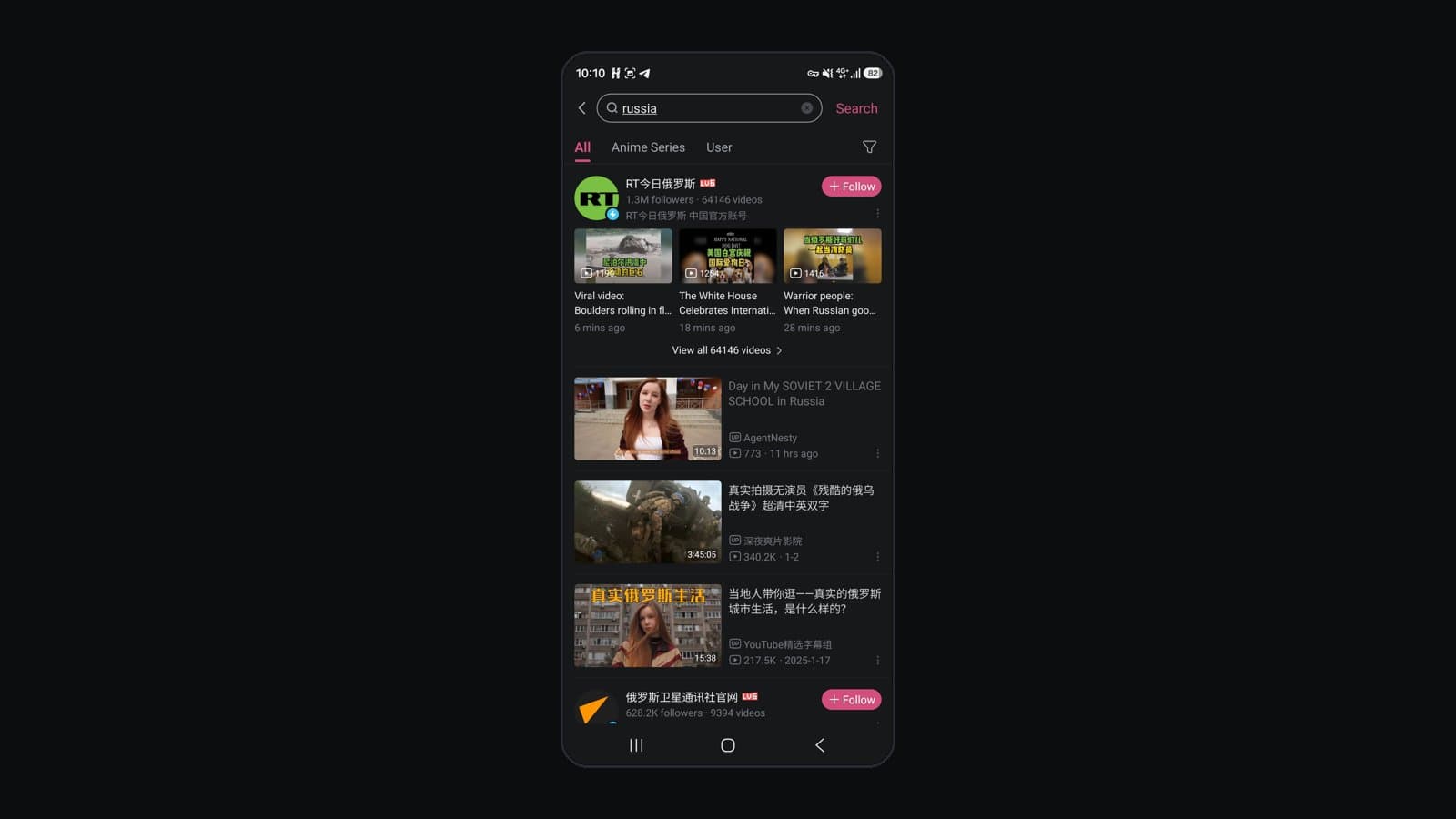
Now look at the gap. The big numbers all belong to state media — RT, Sputnik, war footage pulling 340,000 views. But the independent, authentic stuff, a real person just showing you their day? A creator posting “a day in my Russian village school” was sitting on a few hundred views and sixty-odd followers. The demand is proven and the independent seat is basically empty. That is exactly what early looks like: the audience has already arrived, the creators haven't.
It's a worse fit if you need predictable ad money this month, if your content is hyper-local with no outside angle, if you live on iOS (not out yet), or if you lean hard on licensed music and TV clips.
The money, and exactly what we know
Now the bit everyone's arguing about.
There's a figure going round of about seventy cents per thousand views. I'll be straight: that's a rumour. Nobody's confirmed it, Bilibili hasn't published international rates, payout countries or payment methods, none of it. So don't you dare budget around it. What I can do is tell you what we actually know, and the honest answer today is “not that much yet.” When we know more, we'll post more. I'd rather hold that line than sell you a number.
The safe assumption is dead simple: your Bilibili income is zero until the day you personally watch money land in your account. Everything before that is upside, not a forecast.
Compare that to YouTube, which tells you exactly what you get and has paid it out for years. So you've got one known, slower platform and one unknown, easy one. That's the real trade, laid bare. And the known one is getting harder to enter, not easier — from February 2027 the watch-hours bar for new channels to reach monetisation doubles.
Why this hits different if you're in Russia
Google switched off Russia-based AdSense in 2024. If your account sits in Russia, YouTube can't pay you. Full stop. That's the hole a lot of creators have been living in for two years.
But let me correct what the headlines get wrong, because it flips the advice. Plenty of Western creators making Russian content don't bank in Russia at all. They're in their home country and they get paid fine. For them, Bilibili isn't solving a payment problem, it's a free new audience. No downside.
The genuinely open question is narrower: can a creator based in Russia, with Russian bank details, get paid out of Bilibili? We don't know yet. And Google Play billing is frozen in Russia, so even fan gifts and tips might not work for Russian viewers. So if that's you, go build the audience, but treat the money as unproven until you've withdrawn some yourself.
And before anyone says “but it's Chinese and censored”
Someone always does, and it's fair. You'll get moderated, you might get pulled for the wrong opinion.
But be honest about the alternative. Creators making Russian content got banned off YouTube for no stated reason, demonetised, wiped, especially through 2022 and 2023. Every platform in 2026 moderates. There is no neutral one left standing.
So this isn't Chinese censorship versus a free and open platform. It's just choosing where you're willing to get kicked off, and what you want to say before you are. Go in clear-eyed, never keep your only copy of anything in one place, and treat all of them as rented ground.
Which is the whole point, really
Here's the thread that ties it together, and it's the same thing we say about every platform.
A platform gets you eyes. That's what it's for and that's all it is. Attention. What YouTube taught Russian creators in 2024, and what Bilibili is quietly teaching everyone this year, is that the money — the bit you actually live on — is the bit a platform can switch off, freeze, or simply never turn on.
So stop waiting for a platform to decide whether you get paid.
If you've got something to sell, this is where it gets good. Get on Bilibili, get in front of that Chinese audience, and put your own storefront behind it. That's what we built LiveShelf for. You don't need Bilibili to sort out its international payouts if you've already got your own way to sell to the people it sends you. Attention on the platform, income on something you own. You can be making money today instead of waiting on an announcement in six months.
That's the beauty of it. It works everywhere, for anything, and it doesn't care whose payout system is or isn't live.
What I'd do today, not Monday
Download it now and reserve your name, because names get taken and it costs nothing. Set up your picture and bio while you're in there. Work out your channel's one style — for most people that's easy, they've only got one. Then take your back catalogue, count it, and pace it out rather than dumping the lot on day one. For long-form, no more than two uploads a day, spaced out, because nobody's cracked this algorithm yet and two a day is what holds up everywhere else. Localise properly: real titles and subtitles, not just the auto-dub, which butchers names and jokes.
Then watch what happens across ten or fifteen uploads, not one. Reserve the name, cross-post your strongest evergreen stuff, learn the room, assume zero revenue until money actually arrives.
Be early. Just don't be dependent.
Start with what you're actually selling
If you want the audience but you haven't yet got the thing that turns it into money, that's the part we solve, and it's the part that outlasts any single platform. Have a look at how we think about it, or start with a $300 audit of what you've already got and where it leaks.
Bilibili might be the next emperor of streaming, or it might be the next Vine. Either way, the creators who win are the ones who showed up early and kept their income in their own hands the whole time.
And this story is moving — payouts, iOS, country availability could all change in a month. Drop your email below and you'll get the update the moment we know more.
Frequently asked questions
- Should creators join Bilibili in 2026?
- Reserve your handle and cross-post evergreen content, but don't leave YouTube. Bilibili is a real, profitable platform with over 376 million monthly users in China, and it's free to test. International monetisation isn't confirmed yet, so treat any income as a bonus rather than a plan.
- Can Russian creators make money on Bilibili?
- It depends where your accounts are. Western creators living in Russia who bank in their home country generally get paid fine and can use Bilibili purely to reach a new audience. For creators based in Russia with Russian bank details, payouts are genuinely unconfirmed, and Google Play's payment freeze in Russia may also limit fan-support features. Assume it's unproven until you've withdrawn money yourself.
- Is Bilibili a real YouTube competitor?
- In reach and ambition, yes. In money, not yet. YouTube generated more than fourteen times Bilibili's total revenue in 2025 and pays creators on clear, published terms. Bilibili has the audience and the infrastructure but hasn't given international creators comparable clarity, so it's a serious contender, not a replacement.
Want us to find your leaks for you?
A $300 website and social audit, reviewed the way your customer sees it. Credited to your first month.
Book your audit →Keep reading